
At the beginning of the project, the most important decision had nothing to do with steel, layout, or equipment.
It was a question of use.
The boat we purchased had started life as a 50-foot trawler-type vessel. A previous owner had removed the swim platform, reducing it to 48 feet. By the time we encountered it, it had already been altered once and partially repurposed. It no longer had a single, clear identity. It was neither a working boat nor a coherent cruising one — but something in between, carrying traces of both.
That ambiguity could have been preserved. Instead, it became the first problem that had to be resolved.
The temptation to design forwards
Refits often begin with form.
Layouts are adjusted, spaces opened up, equipment modernised. The assumption is that use will naturally follow once the boat becomes more comfortable, more capable, or more attractive.
That approach works when a boat’s role is already settled.
It works far less well when a boat is being asked to change what it is.
Designing forwards from form tends to preserve contradictions. Spaces are improved without being reconsidered. Old hierarchies remain embedded, even when the activities that created them no longer apply.
What looks like progress can quietly reinforce the past.
A change of role, not of specification
From the outset, this project was not about upgrading a 48-foot trawler. It was about redefining the boat’s role and extending it to 60 feet.
The intention was to create a family liveaboard capable of extended use, while still being able, on occasion, to function as a small dive boat. That combination mattered — but not equally.
The mistake would have been to treat those uses as interchangeable.
Liveaboard use is continuous, domestic, and cumulative. Dive use is episodic, task-focused, and temporary. Designing a boat to support both requires deciding which one sets the rules.
In this case, the answer was clear: the boat would be a liveaboard first, and everything else would adapt to that.
What that decision quietly ruled out
Once that choice was made, several inherited assumptions fell away.
- A raised wheelhouse, once essential for a working boat, became optional.
- Exterior deck priorities shifted away from equipment handling toward circulation and safety.
- Internal movement needed to work when the boat was occupied continuously, not occasionally.
None of those changes required dramatic gestures. They required consistency.
The boat could no longer afford to be two things at once.
Designing backwards as a discipline
Designing backwards from use does not mean predicting every future scenario. It means accepting that some decisions must be made before others can make sense.
Once liveaboard use became the primary lens, questions about space, circulation, and structure began to reorder themselves:
- Which spaces would be occupied daily?
- Which transitions would be habitual rather than occasional?
- Where would interruptions become tiring rather than tolerable?
These questions do not produce drawings. They produce constraints — but they are the right kind of constraints.
They prevent effort being wasted on solving problems that should not exist in the first place.
Why hybrid solutions usually fail
Boats often attempt to remain flexible by refusing to decide.
The result is rarely true adaptability. More often, it is a layering of compromises: spaces that are almost suitable for several uses but fully comfortable for none.
In this case, flexibility came from clarity.
By committing to a primary mode of use, the boat became easier to adapt secondarily. Dive operations could be accommodated because circulation was clear, access was predictable, and storage could be defined honestly — not because the boat remained notionally “multi-purpose.”
Use dictated structure, not the other way around.
How this shaped later decisions
Many of the later structural and spatial decisions — the extended saloon, the central passageway, the internal stairs — can be traced directly back to this early commitment.
They were not attempts to modernise the boat. They were attempts to align it with how it would actually be lived in.
Once that alignment existed, questions about openings, load paths, and circulation stopped competing with each other. They began to agree.
Pausing before building
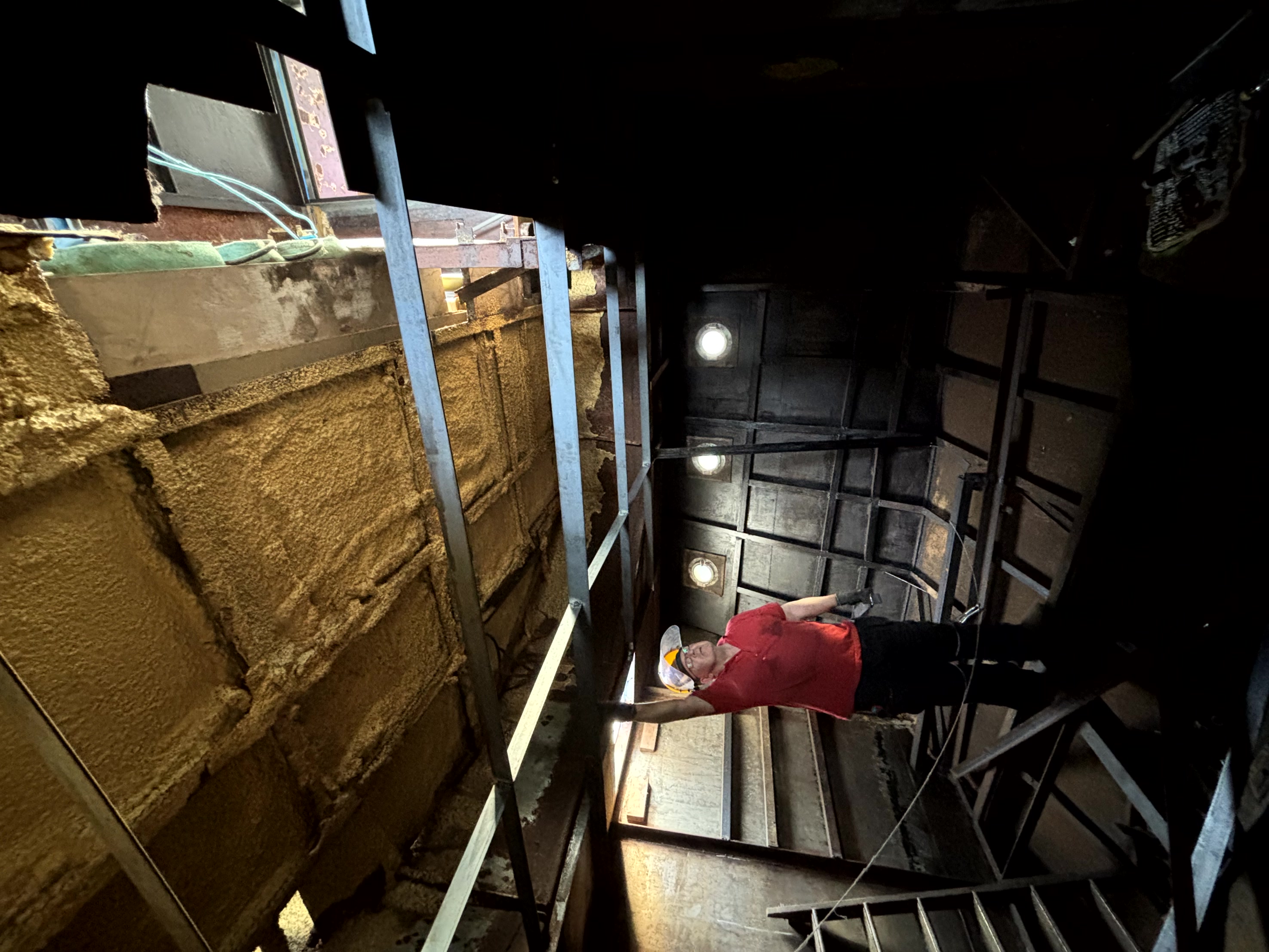
At the time of writing, much of this thinking has already been tested in steel. Other elements remain unbuilt, waiting for the winter shutdown to lift.
What matters is that the boat has already committed to a way of being used. The rest of the refit is now an exercise in making that decision legible.
Designing backwards from use did not simplify the project. It clarified it.
And without that clarity, no amount of good execution would have been enough.
About the Author

Jack Allen is a former Royal Navy seamanship rating, boat skipper, boat builder, and project manager. He is the creator and administrator of HamstersAHOY.com and currently coordinates the HamstersAHOY! Project, converting a derelict 48ft steel trawler into a modern 60ft liveaboard cruiser at Stourport-on-Severn.
Jack holds SMSTS and RYA Day Skipper certifications and is formally trained in the Natural Sciences through the Open University, Manchester University, and Sussex University.
👉 Follow Jack’s latest adventures and his articles at the HamstersAHOY! Project.
Comments