
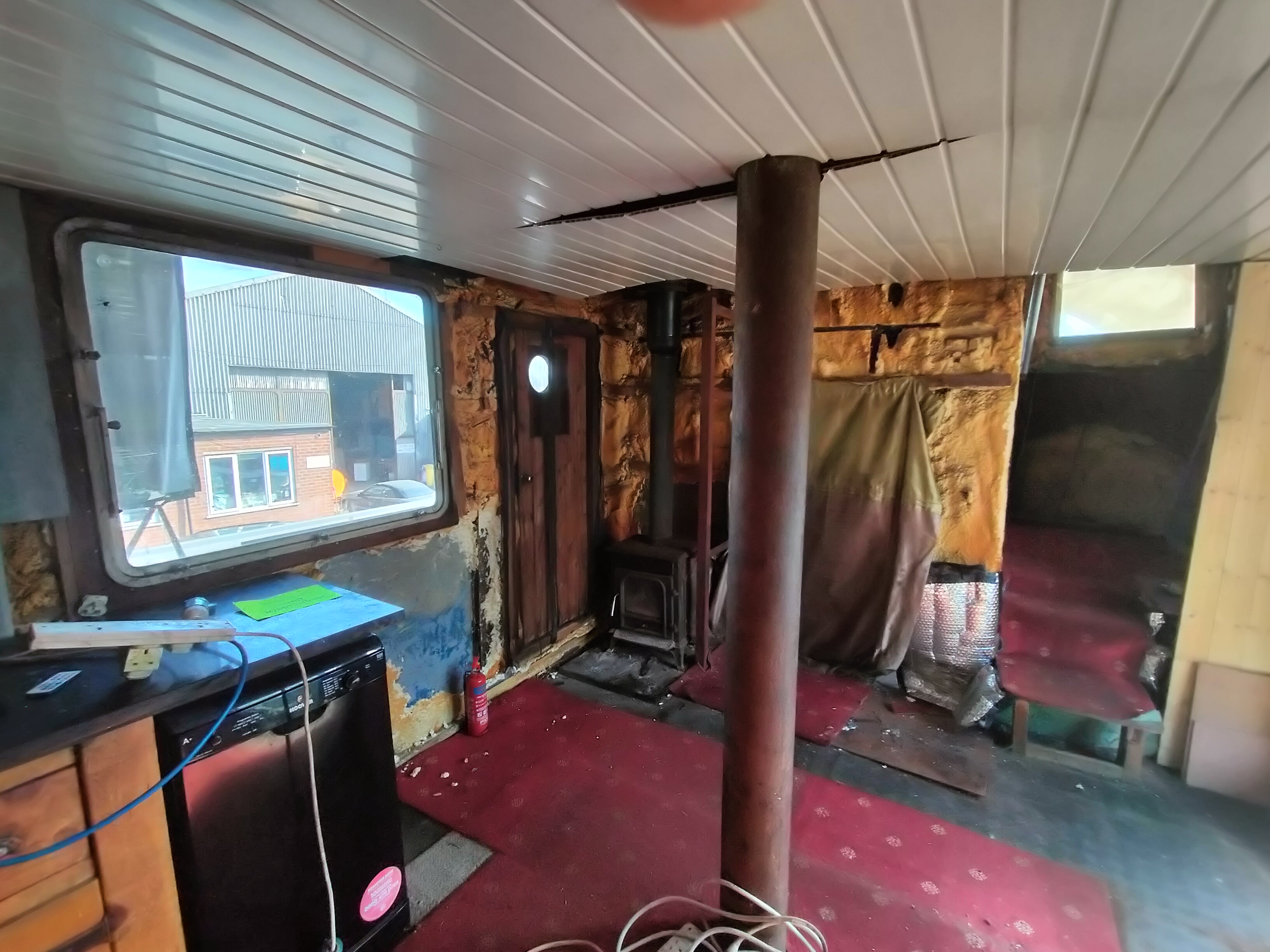
On the original boat, the wheelhouse deck sat approximately two feet above the saloon.
It was a simple difference in height, but it split the interior in ways that were surprisingly profound.
Circulation was interrupted. Furniture layouts were constrained. The saloon felt shorter, less generous, and visually compartmentalised. Structure was implied rather than legible: bulkheads and deck edges appeared to hold the space together, even though the real loads travelled elsewhere.
This Insight looks at what happens when you remove a level: how a seemingly small vertical adjustment can transform both the spatial experience and the structural logic of a boat.
The inherited condition
The raised wheelhouse deck existed for good reason. It elevated the helm for visibility, created a defined working volume, and supported a roof structure above.
But in the context of the new brief — a larger, more flexible saloon capable of functioning as both a family living space and a small dive boat — it became a constraint.
The discontinuity shortened the saloon, fractured circulation, and made the space feel smaller than its plan dimensions suggested. Structural elements that were meant to support above also imposed limits on below. In short, the level made sense historically, but it worked against the new intention.
Rethinking height
The first step was to question what the raised deck actually contributed.
- Did it carry vertical loads that couldn’t be resolved elsewhere?
- Did its elevation serve circulation, access, or operational needs that could not be relocated?
- Could the saloon and roof structure work without it?
Once these questions were answered — through careful inspection, measurement, and testing — the answer became clear: the level was a remnant of the boat’s previous role. It could be removed, but only if the continuity of structure above and below was preserved.
This was not demolition; it was redefinition.
Aligning structure and space
Removing the level required the saloon deck, the accommodation deckhead, and the roof above to function as a single, continuous volume.
The vertical load paths already established through steel members and RSJs (described in “Carrying Loads Vertically”) allow this to happen. The old wheelhouse deck can be carefully deconstructed to be integrated into the continuous plane of a new saloon deck.
Where the former bulkheads intersected the old level, they were retained selectively: only where they contributed to real load paths, or where they could help define circulation without breaking the spatial flow.
The result was a saloon that reads as one uninterrupted volume. Circulation is continuous. Furniture placement, light, and access all respond to a single geometric logic rather than a series of inherited steps.
Spatial consequences
The impact of removing a level goes beyond measurable dimensions.
- Eight feet of continuous internal length were reclaimed, but the saloon now feels longer because nothing interrupts the sightlines.
- Ceiling heights and deck planes align visually, reinforcing a sense of openness.
- Circulation paths are legible: movement from deck to deck, and forward to aft, is intuitive rather than forced.
- Structural elements, now integrated into vertical supports or carefully retained bulkheads, no longer appear as barriers but as organisers of space.
Linking levels to openings
This Insight also clarifies why the saloon doors and windows could eventually be reconfigured symmetrically.
With the level removed, openings no longer had to negotiate discontinuous floors or ceilings. Circulation aligned naturally with structural elements, and windows and doors could be placed where they made sense both functionally and visually.
Here again, structure enables spatial logic: the vertical support system supports the roof, the deck carries loads downward, and the openings respond to the resulting, legible volume.
Reflection
Removing a level might sound simple — two feet here or there — but in a boat, vertical continuity is deeply entwined with structure, circulation, and perception.
By taking the decision to strip away the historical wheelhouse deck, the team was able to create a saloon that is longer, more open, and more flexible, without adding new structure unnecessarily. Every load has a path, every vertical element is legible, and every movement through the space feels natural.
In other words, the boat now carries itself differently, not through more material or heavier bulkheads, but through clearer logic in height, volume, and sequence.
For now, that clarity is enough to pause and reflect — before the next layers of the superstructure and interior are added.
About the Author

Jack Allen is a former Royal Navy seamanship rating, boat skipper, boat builder, and project manager. He is the creator and administrator of HamstersAHOY.com and currently coordinates the HamstersAHOY! Project, converting a derelict 48ft steel trawler into a modern 60ft liveaboard cruiser at Stourport-on-Severn.
Jack holds SMSTS and RYA Day Skipper certifications and is formally trained in the Natural Sciences through the Open University, Manchester University, and Sussex University.
👉 Follow Jack’s latest adventures and his articles at the HamstersAHOY! Project.

Comments