
At present, there is no passageway.
What exists instead is the framework that makes one unavoidable.
During the current winter shutdown, the accommodation spaces forward of the saloon remain largely undefined. There are no finished bulkheads, no doors, no linings. What has been completed is the structural work that fixes how loads travel through the boat — and, by extension, how people will move through it.
The passageway has not yet been built, but the boat has already decided to have one.
The inherited assumption
On many boats of this size, accommodation is arranged opportunistically rather than deliberately. Cabins are placed where volume appears, and circulation is threaded between them as space allows.
The result is often a series of compromises: narrow corridors that exist only where structure permits, cabins entered through other cabins, and walls that are thicker than they need to be because they are quietly doing structural work as well as spatial work.
This approach can function perfectly well for short-term use. It becomes much less forgiving once a boat is expected to operate as a liveaboard — or to accept change over time without unpicking half of what has already been built.
The underlying problem is not layout, but honesty. When structure is hidden inside accommodation, circulation becomes an afterthought.
What the structure forced us to admit
As the saloon was extended forward and the former wheelhouse deck rebuilt at saloon level, it became necessary to carry new vertical loads down into the hull.
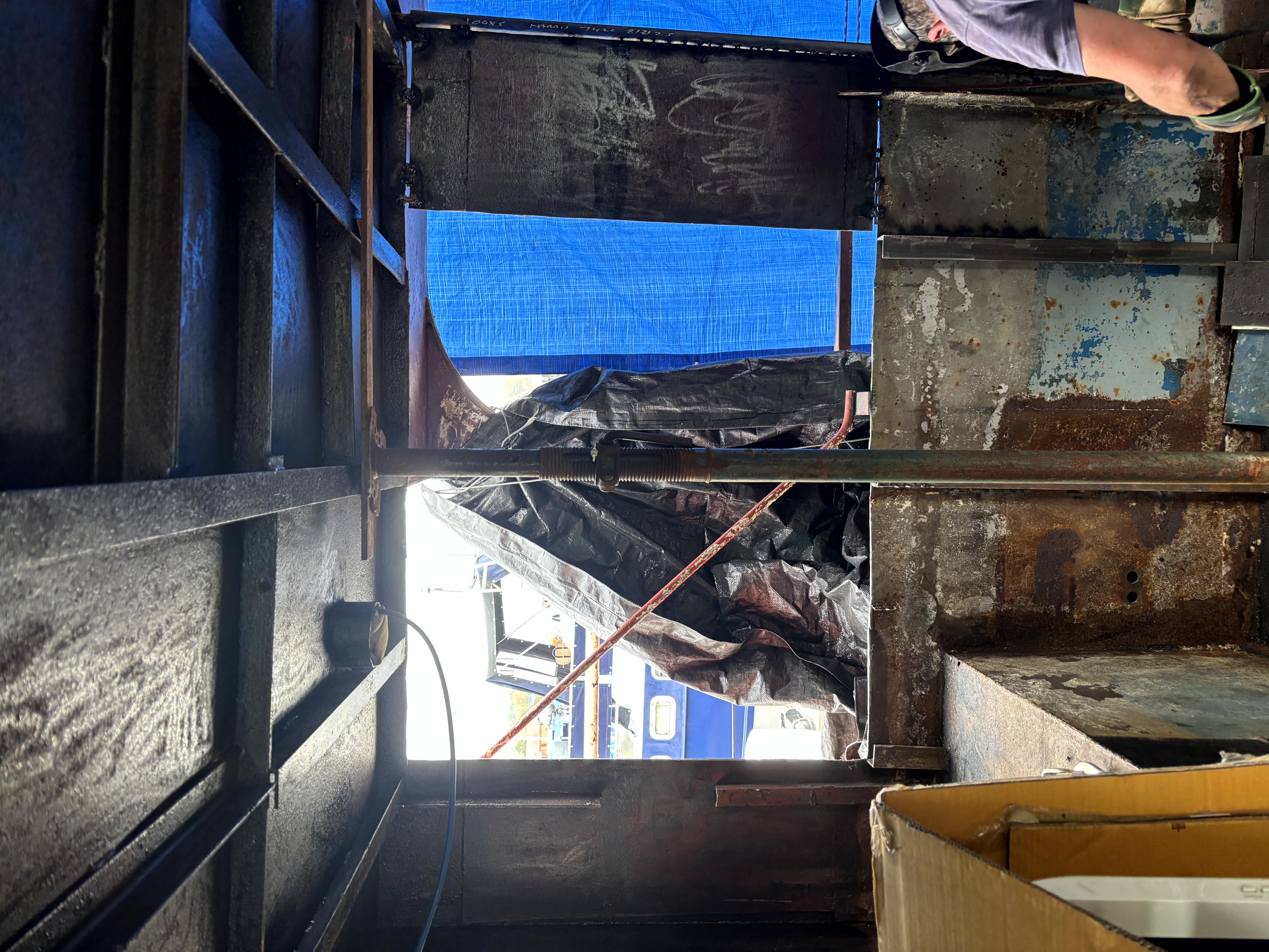
Those loads could not be dispersed casually. They required clear, continuous paths: vertical steel strong points running from the new deck framing down through strengthening RSJs to the double keel.
Once those elements were in place, something became obvious.
The structure already described a line — straight, fore-and-aft, and central. Trying to build accommodation across that line would mean either disguising structure inside walls, or forcing circulation to detour around it.
Neither option was appealing.
Rather than hiding the strong points, we allowed them to define the space between them. What emerged was not a design feature, but a consequence: a central passageway formed by the logic of the loads themselves.
The decision that followed
The decision was not to add a corridor, but to commit to one early.
By accepting a central passageway as the primary organising element, several things became simpler at once:
- Vertical loads could remain visible, legible, and accessible
- Accommodation spaces could be arranged symmetrically either side
- Walls could be walls, rather than structural disguises
- Circulation could remain continuous and predictable
Most importantly, future changes would not require structural archaeology. The boat would be able to evolve without needing to pretend it had always been built that way.
Why the passageway is not yet built
It would be possible to frame the passageway now — to fix its width, line it out, and start turning steel into rooms.
We have chosen not to.
The winter shutdown provides a natural pause in which the structure can be observed behaving as intended, without the pressure to enclose it prematurely. Decisions about width, openness, and degree of separation from adjacent accommodation will be made once the boat reopens and the space can be judged in use, not in plan.
What matters is that the passageway’s role is already fixed, even if its surfaces are not.
What this changes about accommodation
When the passageway is eventually built, it will appear deliberate — even inevitable. But it will not be a gesture.
It will separate movement from rest, allowing the saloon to function as a social space without becoming a thoroughfare. It will allow cabins to remain private without being isolated. And it will let structure remain honest, rather than smuggled into furniture or linings.
The accommodation will work not because it is efficient, but because it is aligned.
Pausing at the right moment
For now, the passageway exists only as steel, alignment, and intent.
That is enough.
By deciding the spine before building the body, the boat has already resolved a problem that often remains latent until it is too late to fix cleanly. When the space is finally built, it will not be discovering its purpose — only expressing it.
And that makes this a natural point to pause, reflect, and record the thinking — before the next layer goes on and makes the decision look effortless.
About the Author

Jack Allen is a former Royal Navy seamanship rating, boat skipper, boat builder, and project manager. He is the creator and administrator of HamstersAHOY.com and currently coordinates the HamstersAHOY! Project, converting a derelict 48ft steel trawler into a modern 60ft liveaboard cruiser at Stourport-on-Severn.
Jack holds SMSTS and RYA Day Skipper certifications and is formally trained in the Natural Sciences through the Open University, Manchester University, and Sussex University.
👉 Follow Jack’s latest adventures and his articles at the HamstersAHOY! Project.
Comments