
At present, there are no stairs.
What exists instead is a saloon that has already been asked to accommodate them.
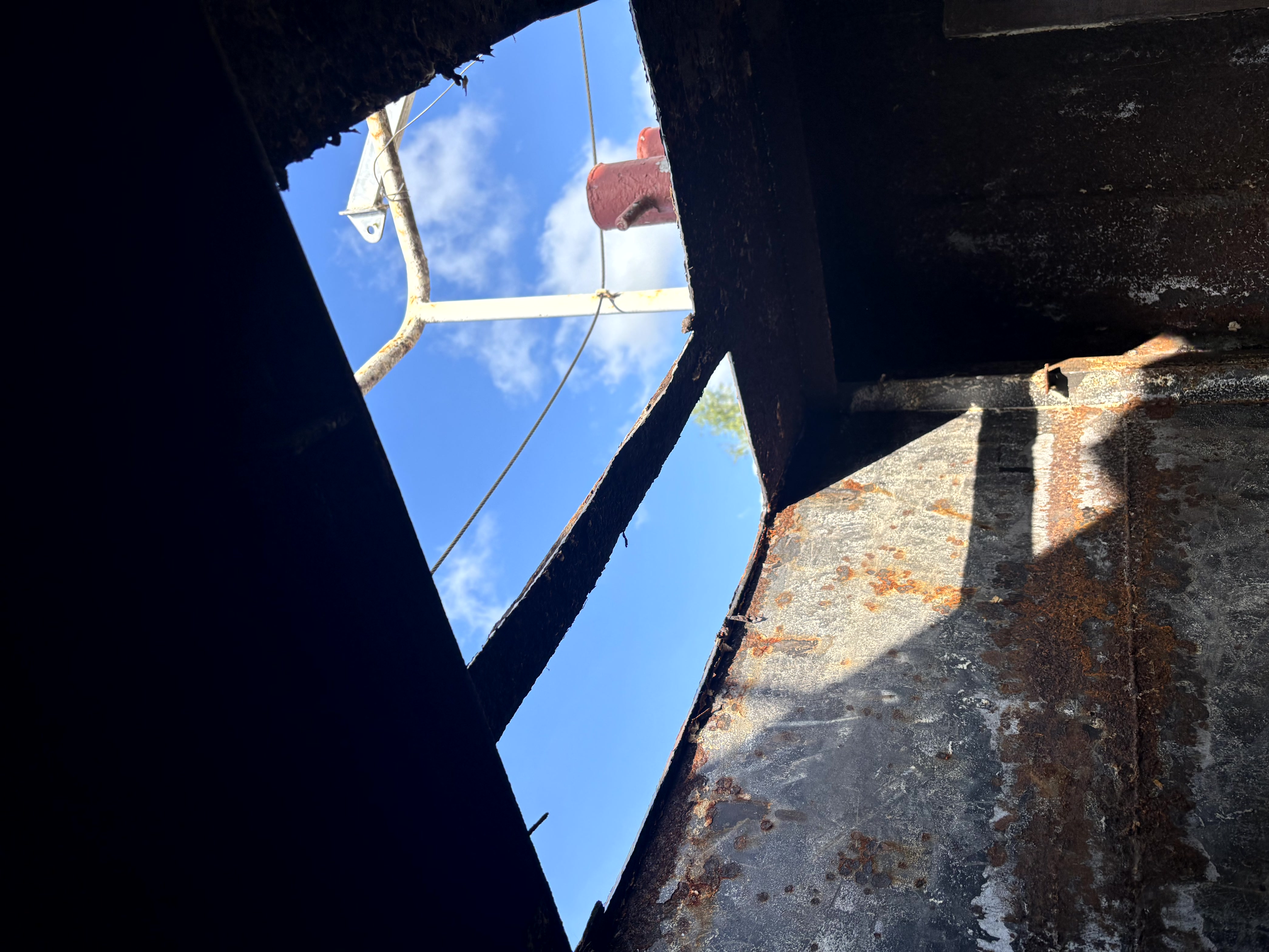
Although the former wheelhouse roof remains in place during the current winter shutdown, its future removal — and the lowering of the wheelhouse deck to saloon level — has already fixed how the interior will be expected to work. The saloon is no longer being treated as a terminal space. It is being prepared to become a junction — the point at which movement through the boat will converge.
That change makes vertical circulation unavoidable. The question is not whether stairs are needed, but how they can exist without undoing the openness the refit has already committed to.
The usual mistake
On many boats, stairs are treated as problems to be hidden.
They arrive late in the design process, once rooms have claimed their territory, and are forced into whatever volume remains. The result is familiar: steep steps, boxed-in landings, and abrupt transitions that make moving between levels feel like leaving one boat and entering another.
This approach is not usually the result of poor workmanship. It is the result of stairs being considered furniture rather than spatial structure.
When stairs are added late, they fracture space. When they are considered early, they can do the opposite.
A saloon that must remain whole
Even before the physical removal of the wheelhouse roof, the saloon has been committed to a broader role. It is expected to become a social space, a circulation hub, and the point of connection between accommodation below and the future wheelhouse above.
That expectation alone makes it sensitive to interruption.
Any stair that dominates the saloon — visually or structurally — would undermine the openness the refit is working toward. At the same time, hiding vertical movement altogether would deny the saloon its intended role as the centre of the boat.
The solution was not to concentrate movement, but to distribute it.
Two stairs, not one
Rather than stacking stairs or combining upward and downward movement into a single feature, the decision was made to separate them.
- Access down to the accommodation will be via an internal stair forward on the port side of the saloon.
- Access up to the new wheelhouse will be via a complementary internal stair forward on the starboard side.
Both stairs will originate within the saloon. Neither is secondary. And neither attempts to do more than one job.
This separation allows each stair to be read clearly for what it is: one leading toward privacy and retreat, the other toward outlook and command.
Why position matters more than form
The exact construction of the stairs has not yet been finalised. What has been fixed is their relationship to structure, circulation, and sightlines.
By placing both stairs forward:
- They align naturally with the longitudinal logic of the boat
- They anticipate the central passageway already established below
- They avoid cutting the saloon into fore and aft zones
By placing them to port and starboard respectively:
- No single stair becomes dominant
- Movement is distributed rather than funnelled
- The saloon remains readable as one volume
Crucially, neither stair is required to carry primary structural loads. Those loads are already being handled by the steel framework beneath and around them. This allows the stairs to remain open, legible, and light — even before any decisions about materials are made.
Sightlines as a form of orientation
On a boat, sightlines are not aesthetic luxuries. They are functional cues.
From the saloon, it should be immediately apparent:
- Where one will go to reach accommodation
- Where one will go to reach the wheelhouse
- How those movements relate to the length and orientation of the hull
By keeping the stairs internal but visually restrained, the saloon can acknowledge vertical movement without being consumed by it. You are aware of where you will be able to go, even before those paths are physically open.
That awareness makes the space calmer to use — particularly when the boat is busy, or when movement becomes routine rather than occasional.
Why the stairs have not yet been built
As with the passageway, the absence of finished stairs is deliberate.
The structure that defines their positions is in place. The saloon has already been asked to accept their presence. What remains is to judge their exact openness, pitch, and enclosure once the wheelhouse roof is removed and the space can be experienced as a single volume.
Building them now would risk fixing decisions that are better made at full scale, in light and in use.
Waiting does not delay the project. It protects it.
Vertical movement without hierarchy
Once the old wheelhouse is fully repurposed as a saloon extension, moving up or down will no longer represent a change in mode — from work to leisure, or inside to outside.
It will simply be movement within the same boat.
Placing both stairs internally acknowledges that shift. Vertical circulation becomes part of daily life rather than an exception to it, and the saloon remains the place where those paths quietly intersect.
Pausing before expression
For now, the stairs exist only as intention, alignment, and negative space.
That is enough.
They have already shaped the saloon by not demanding attention, by not carrying loads they do not need to carry, and by allowing space to remain continuous even as movement becomes more complex.
When they are finally built, they will not announce themselves. They will simply confirm what the boat already knows.
And that makes this a natural moment to pause — before steel turns into steps, and decisions turn into objects.
About the Author

Jack Allen is a former Royal Navy seamanship rating, boat skipper, boat builder, and project manager. He is the creator and administrator of HamstersAHOY.com and currently coordinates the HamstersAHOY! Project, converting a derelict 48ft steel trawler into a modern 60ft liveaboard cruiser at Stourport-on-Severn.
Jack holds SMSTS and RYA Day Skipper certifications and is formally trained in the Natural Sciences through the Open University, Manchester University, and Sussex University.
👉 Follow Jack’s latest adventures and his articles at the HamstersAHOY! Project.
Comments