
Refitting an older steel working boat is rarely a matter of repairing one thing at a time. Structural defects tend to overlap, access is constrained by the boat’s own geometry, and weather often dictates priorities more forcefully than planning ever could.
The critical mistake is to approach the work as a list of isolated tasks. In reality, successful progress depends on sequencing — understanding which elements must be stabilised first so that later work is not wasted or undone.
1. Stabilise the envelope before improving the interior
No internal work should be considered durable until the hull, bulkheads, and deck structure can reliably keep water out. In practice, this means prioritising:
- Hull-side corrosion treatment
- Bulkhead integrity
- Roof and deck support
- Temporary plating where permanent repair must wait
Even imperfect or temporary solutions are preferable to proceeding inside a boat that remains exposed. Insulation, framework, and systems installed too early will simply have to be removed again.
2. Treat missing or compromised framework as structural debt
Older boats often show signs of past modifications: removed frames, cut bulkheads, or improvised supports. These are not cosmetic issues.
Before layout decisions or systems routing, internal framework must be:
- Identified
- Restored to carry original (or revised) loads
- Integrated into future deckhead and deck extensions
Ignoring missing framework simply shifts failure forward in time — usually to a point where repair becomes far more invasive.
3. Work outward when cutting, inward when finishing
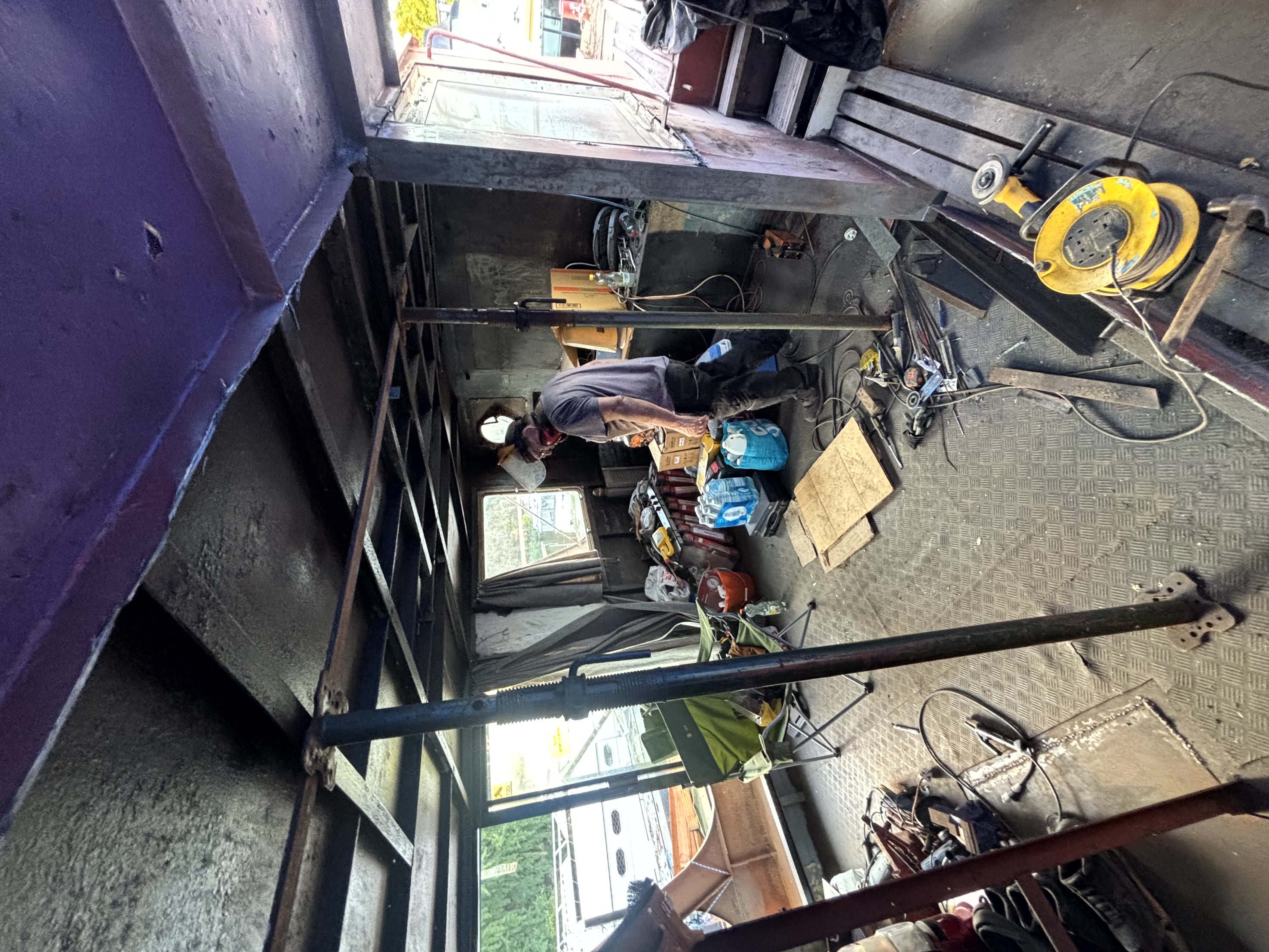
Structural steelwork often requires opening the boat to complete it properly: removing windows, cutting access holes, or temporarily destabilising bulkheads.
This work should be grouped and completed decisively while conditions allow. Once the structure is re-secured and the envelope restored, the project should pivot inward — toward slower, controlled work that can tolerate poorer weather and reduced daylight.
4. Let weather dictate when, not what
In the UK especially, seasonal constraints are not an inconvenience — they are a design parameter.
External work should be scheduled opportunistically and executed aggressively when conditions permit. Internal work should be selected not for satisfaction, but for survivability: tasks that can proceed in cold, damp, low-light environments without risking rework.
This inevitably leads to periods of triage rather than progress. That is normal.
5. Accept the point of commitment consciously
There comes a moment when structural assumptions harden into reality: materials are ordered, layouts become fixed, and alternative paths quietly close.
That moment should be recognised for what it is. From that point onward, the question is no longer “Should this be done?” but “How do we carry it through responsibly?”
Projects that survive this transition do so because they accept constraint, not because they defeat it.
From the build
The principles above were applied during the refit of a 48-foot steel trawler-type liveaboard between early and late summer, as the project shifted from investigation to structural commitment under increasing weather pressure.
Relevant build logs:
- Log #05 — Interior Steelwork & Deck Preparation
- Log #06 — Drawing the Line
- Log #07 — Racing Against Winter
About the Author

Jack Allen is a former Royal Navy seamanship rating, boat skipper, boat builder, and project manager. He is the creator and administrator of HamstersAHOY.com and currently coordinates the HamstersAHOY! Project, converting a derelict 48ft steel trawler into a modern 60ft liveaboard cruiser at Stourport-on-Severn.
Jack holds SMSTS and RYA Day Skipper certifications and is formally trained in the Natural Sciences through the Open University, Manchester University, and Sussex University.
👉 Follow Jack’s latest adventures and his articles at the HamstersAHOY! Project.
Comments