
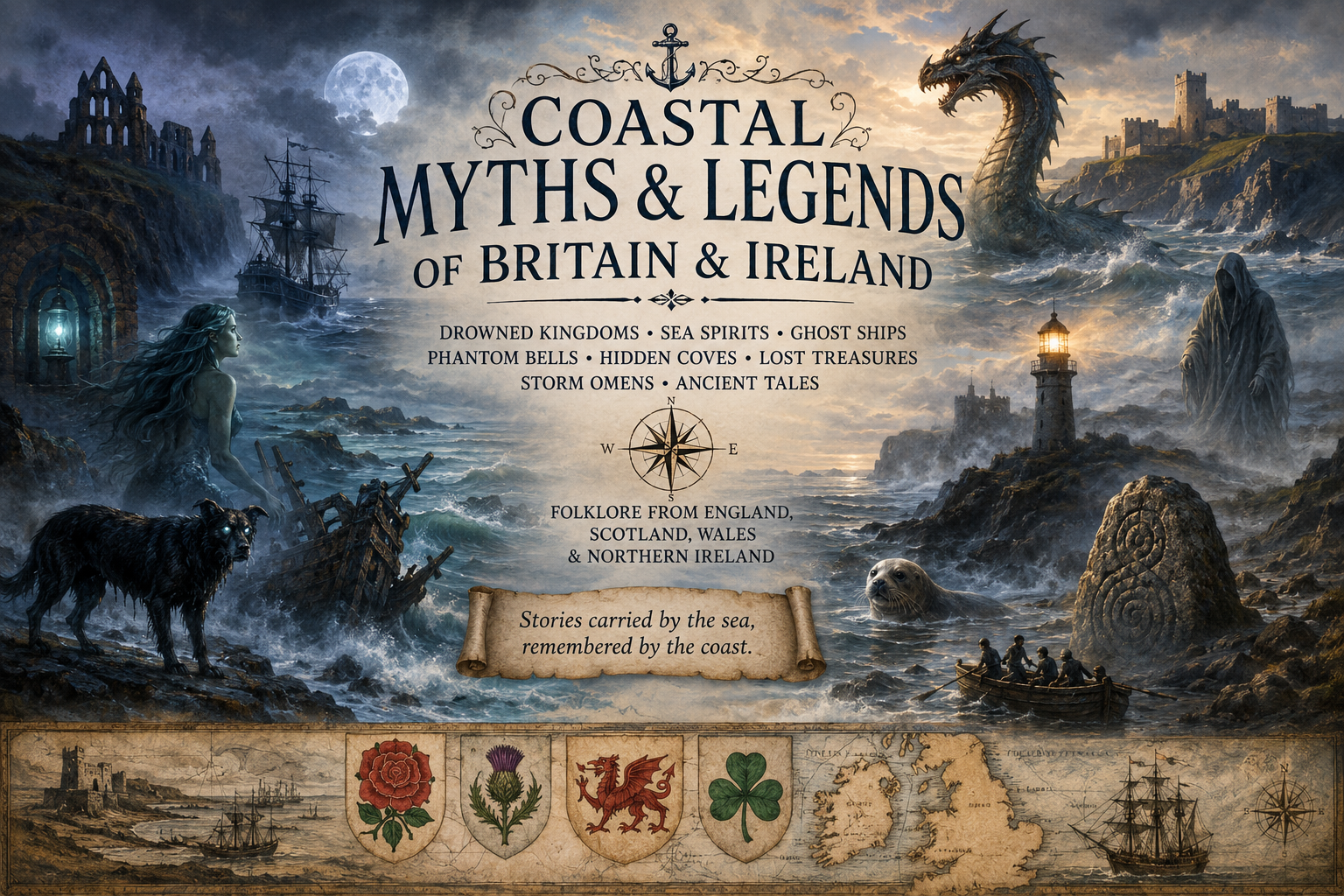


The coast of Carmarthenshire, extending along the northern reaches of the Bristol Channel from Pendine Sands to the estuary of the River Loughor, has long carried associations with Merlin, or Myrddin, the prophetic figure of early Welsh tradition. Although much of the surviving legend belongs to inland districts and medieval poetry rather than directly to seafaring life, the western shores of Wales were widely regarded in earlier centuries as part of the landscape through which the Merlin traditions moved and endured. Along the coast between Laugharne, Kidwelly and Carmarthen Bay, references to Myrddin persisted in local antiquarian writing well into the nineteenth century.
The association is moderate rather than dominant. Carmarthenshire was historically linked with the old Welsh kingdom of Dyfed, where early Celtic legend remained strong after much of eastern Britain had adopted different traditions. Some medieval texts connect Myrddin with wooded valleys and remote western country beyond the Tywi estuary, while later folklore placed prophetic sayings and natural signs along the tidal rivers entering Carmarthen Bay. These traditions were never confined solely to the sea, yet coastal communities absorbed them into local understanding of weather, tides and landscape. The broad estuarial waters of the Towy and Taf, frequently altered by shifting sands and strong tidal movement, encouraged a practical respect for signs, warnings and inherited local knowledge.
Carmarthen itself has often been cited in connection with Merlin through the similarity between the town’s Welsh name, Caerfyrddin, and the name Myrddin. Modern scholarship treats the connection with caution, suggesting the place-name likely predates the literary figure. Nevertheless, the belief became firmly rooted in regional tradition by the medieval period. Mariners entering the Towy estuary or anchoring within Carmarthen Bay would have known the district as one associated with old prophecies and stories attached to the western country. Such matters were generally regarded in a restrained manner, more as inherited local character than as articles of firm belief.
The waters themselves are notable for strong tidal ranges, exposed sands and frequent changes in channel depth. Before modern harbour works and navigation marks, approaches to Laugharne and Kidwelly demanded close local knowledge, particularly in poor visibility or strong onshore weather from the south-west. In earlier generations, fishermen and small coasting crews commonly retained fragments of folklore alongside practical seamanship. Along this coast, references to Merlin occasionally appeared in sayings concerning storms, unusual tides or the perceived temperament of the bay. These were less supernatural warnings than expressions of respect for a coastline capable of rapid alteration under wind and tide.
Local tradition also linked certain headlands and ancient earthworks overlooking the coast with prophetic or bardic associations. The low cliffs east of Pendine and the marsh country surrounding the Gwendraeth estuary possess a subdued and ancient character which encouraged such interpretations. Antiquarian accounts from the eighteenth and nineteenth centuries occasionally recorded stories of hidden knowledge, lost kingdoms beneath estuarial sands, or predictions attached to the fortunes of Welsh settlements. Most cannot be verified beyond oral tradition, and few were uniquely maritime in nature, though coastal communities repeated them readily enough.
Unlike the harsher seafaring folklore of parts of Cornwall or the Northern Isles, the traditions of the Carmarthenshire coast are quieter and more historical in tone. The Merlin association survives chiefly as part of the cultural landscape of west Wales, where estuaries, tidal flats and ancient settlements have long been tied to early Welsh legend. For mariners passing the shallow waters of Carmarthen Bay or approaching the river mouths under grey Atlantic weather, the stories form a modest but enduring accompaniment to a coast shaped as much by memory and language as by tide and rock.

Comments