
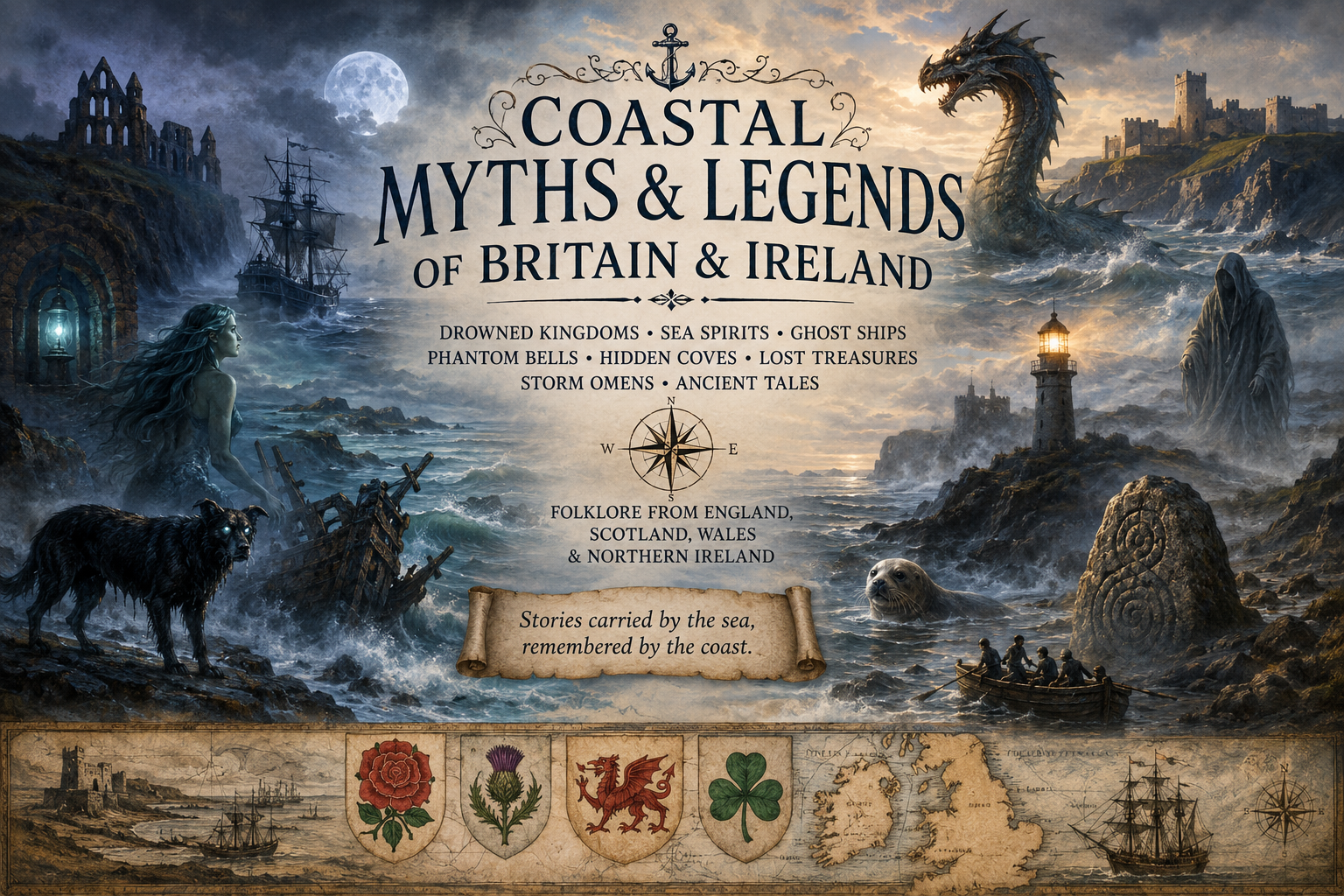



The tradition of Cantre’r Gwaelod, commonly described as a drowned lowland lying beneath the waters of Cardigan Bay, forms one of the strongest and most enduring bodies of maritime folklore associated with the Welsh coast. Though the legend belongs principally to the shores of Cardigan Bay and the western approaches to Wales rather than the northern coast alone, it has long been familiar to mariners navigating the waters between Bardsey Sound, the Llŷn Peninsula and the approaches eastward toward the Dee estuary. The tale concerns a fertile coastal territory said to have been protected from the sea by embankments or sluices before inundation during a great flood. Medieval Welsh sources refer to the tradition in varying forms, though its precise historical basis remains uncertain.
The low and shifting character of parts of the Welsh coast has undoubtedly contributed to the persistence of the story. Extensive shallows, sandbanks and drowned forest remains are found in several districts bordering Cardigan Bay, particularly after severe weather or exceptional tides. Along stretches of the western Welsh coast, submerged tree stumps are occasionally exposed at low water, giving rise to longstanding local belief that cultivated land once extended farther seaward. Similar coastal evidence is known elsewhere around Britain, but in Wales it became firmly attached to the memory of Cantre’r Gwaelod. The gradual encroachment of the sea upon reclaimed or low-lying land is historically well attested in many estuarial districts, lending a degree of geographical credibility to what later assumed legendary form.
Among coastal communities the story became closely connected with the hazards of tides and weather. In former centuries Welsh fishermen and coasting seamen were said to remark upon unusual sounds carried across still water in Cardigan Bay, occasionally interpreted as distant bells from the drowned settlement below the sea. Such beliefs were neither universal nor consistently recorded, and should be regarded as part of local oral tradition rather than established maritime custom. Nevertheless, references to submerged church bells occur frequently enough in Welsh folklore collections to suggest a genuine regional association. The broad tidal reaches and changing sea conditions of the bay, particularly in periods of swell and offshore wind, readily produce unusual acoustic effects that may have encouraged such interpretations.
The folklore also reflects practical awareness of the sea’s unpredictability along this coast. Cardigan Bay and the northern Welsh approaches are subject to rapid alterations in visibility, strong onshore weather from the Irish Sea, and confused seas off headlands such as Great Orme, Bardsey Island and the western extremities of the Llŷn coast. Harbours historically used by small craft, including Pwllheli, Porthmadog and Aberdyfi, demanded careful attention to tides and bar conditions. In this context the tradition of land lost to the sea carried an obvious moral significance for coastal populations dependent upon safe navigation and secure shoreline settlement.
By the nineteenth century the legend had become widely noted by antiquarians, travellers and compilers of Welsh folklore. Some attempted to interpret it as distant memory of post-glacial flooding or coastal subsidence, while others regarded it chiefly as a moral tale concerning neglect and catastrophe. Neither explanation can be conclusively proved. What remains clear is that the story persisted most strongly in communities with direct experience of tidal waters, exposed shores and the continual reshaping of the coastline by storms and sediment movement.
Today Cantre’r Gwaelod retains a notable place in the maritime character of Wales. For vessels passing the North Wales Coast and the western approaches beyond, the legend remains closely tied to the broad tidal waters, submerged banks and weathered shores that have long shaped both navigation and local memory along this part of the Irish Sea.


Comments