
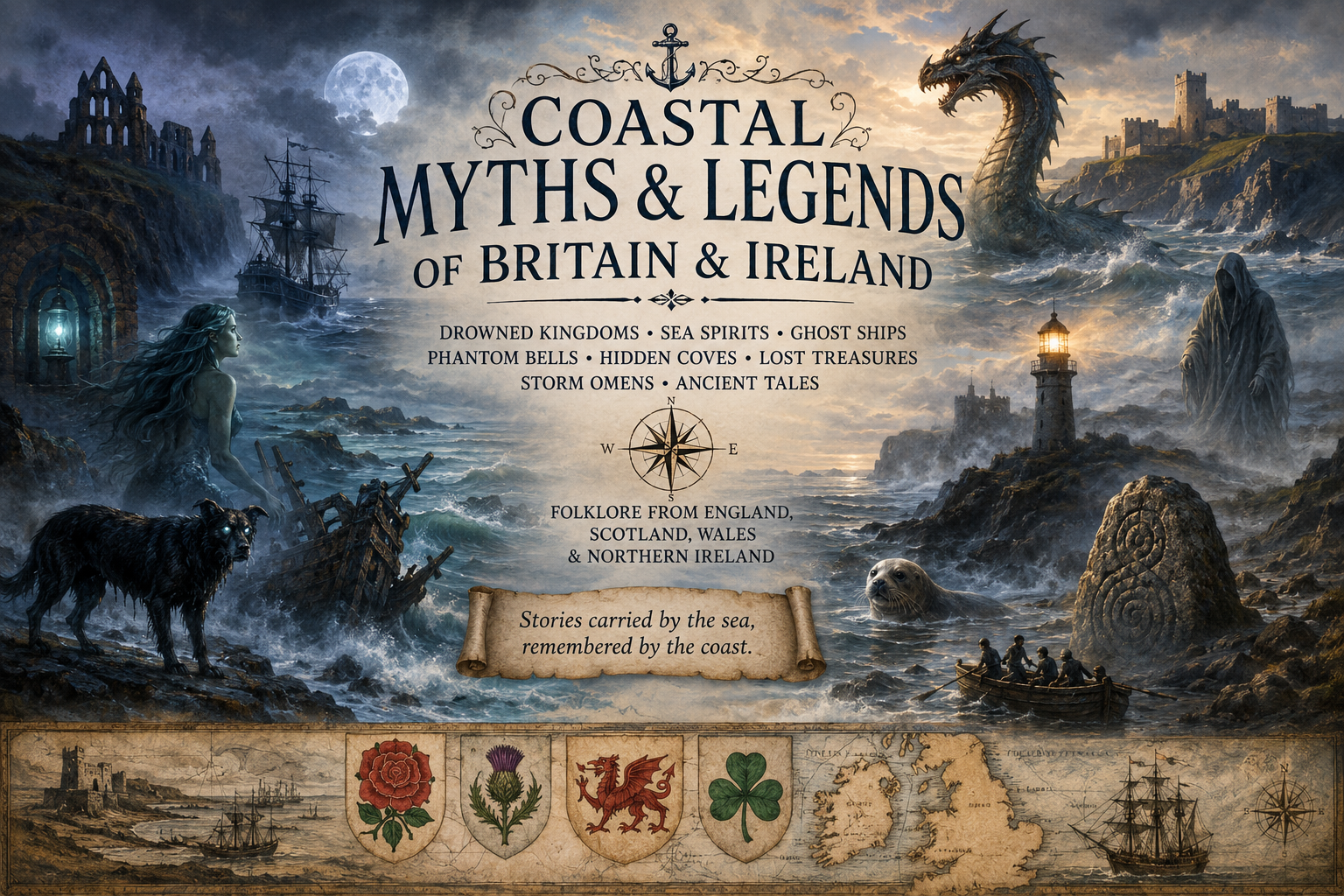



The waters between northern Jura and Scarba contain the Gulf of Corryvreckan, long regarded as one of the most formidable tidal races on the western coast of Scotland. The whirlpool which forms there on strong tides has attracted maritime folklore for centuries, and the surrounding districts of Mull, Jura and Islay retain some of the strongest traditional associations with dangerous seas anywhere in the Hebrides. The legends are closely tied to the observable conditions of the channel itself, where Atlantic swell, uneven seabed and tidal flow combine to produce violent overfalls and heavy rotary seas in suitable weather.
The name Corryvreckan is commonly rendered from the Gaelic Coire Bhreacain, often interpreted as the “cauldron” of Breckan. Tradition associates the whirlpool with the Norse prince Breckan, who is said to have attempted to anchor in the gulf for several nights in order to prove himself worthy of marriage to a local ruler’s daughter. In most versions of the account, his vessel was eventually overwhelmed by the sea. The story has numerous local variations, and while its precise antiquity is uncertain, the association between the whirlpool and the loss of mariners is longstanding. Medieval clerical writers and later travellers alike referred to the dangers of the passage, though often with considerable embellishment.
Among seafarers of the Inner Hebrides, the gulf acquired a practical as well as legendary reputation. Fishermen and coasting crews commonly timed their passages through the Sound of Jura to avoid the strongest tidal streams, particularly in poor visibility or against prevailing westerly weather. Older local accounts describe the roar of the race being audible from the cliffs of Scarba and northern Jura during springs. The sea conditions themselves, rather than supernatural interpretation, appear to have shaped much of the folklore. In Gaelic oral tradition, dangerous whirlpools and tide races were frequently personified, and Corryvreckan became a notable example of a sea place demanding caution and respect.
Some traditions describe the whirlpool as inhabited by the Cailleach Bheur, the hag or winter spirit of Highland folklore, who was said to wash her plaid within the gulf as the seasons turned. Such references belong more properly to wider west Highland seasonal mythology than to seafaring superstition alone, yet they became attached to the locality through repeated retelling in coastal communities. The imagery of a great washing or boiling cauldron corresponded naturally with the appearance of the water under heavy tidal conditions. Mariners familiar with the area generally treated such stories as part of local inheritance rather than literal belief.
The nearby coasts of Mull and Islay possess related traditions concerning strong tides, unpredictable weather and hazardous headlands. Around the Ross of Mull and the western approaches to Islay, oral accounts often linked sudden squalls or confused seas with places already regarded as dangerous to navigation. In this respect the folklore of Corryvreckan forms part of a broader Hebridean maritime culture in which seamanship, local knowledge and respect for tide and weather were closely intertwined. Harbours such as Craighouse on Jura and small anchorages within the Sound of Luing historically served as waiting places for favourable water before attempting difficult passages.
Modern tidal predictions and engine reliability have reduced some of the uncertainty once associated with these waters, though the gulf remains hazardous in unsuitable conditions and is still avoided by many small craft at peak streams. The survival of the legends owes much to the physical character of the place itself. Few coastal traditions in Britain are so directly connected to a visible and continuing maritime hazard.
The folklore of Corryvreckan remains inseparable from the tidal waters and exposed channels of South Argyll, where the sea continues to shape both navigation and local memory.


Comments