

The Moray Firth, opening broadly into the North Sea between the headlands of eastern and northern Scotland, carries a modest body of maritime folklore that has long been noted in pilotage remarks and coastal recollections. Among these, references to water-horse traditions—commonly grouped under the term “kelpie” in Lowland and northern Scottish usage—appear intermittently in association with river mouths and inshore waters, though their distribution is neither uniform nor firmly documented in all localities. Such material is best regarded as part of a wider Highland and coastal belief system rather than a set of precise, site-specific legends.
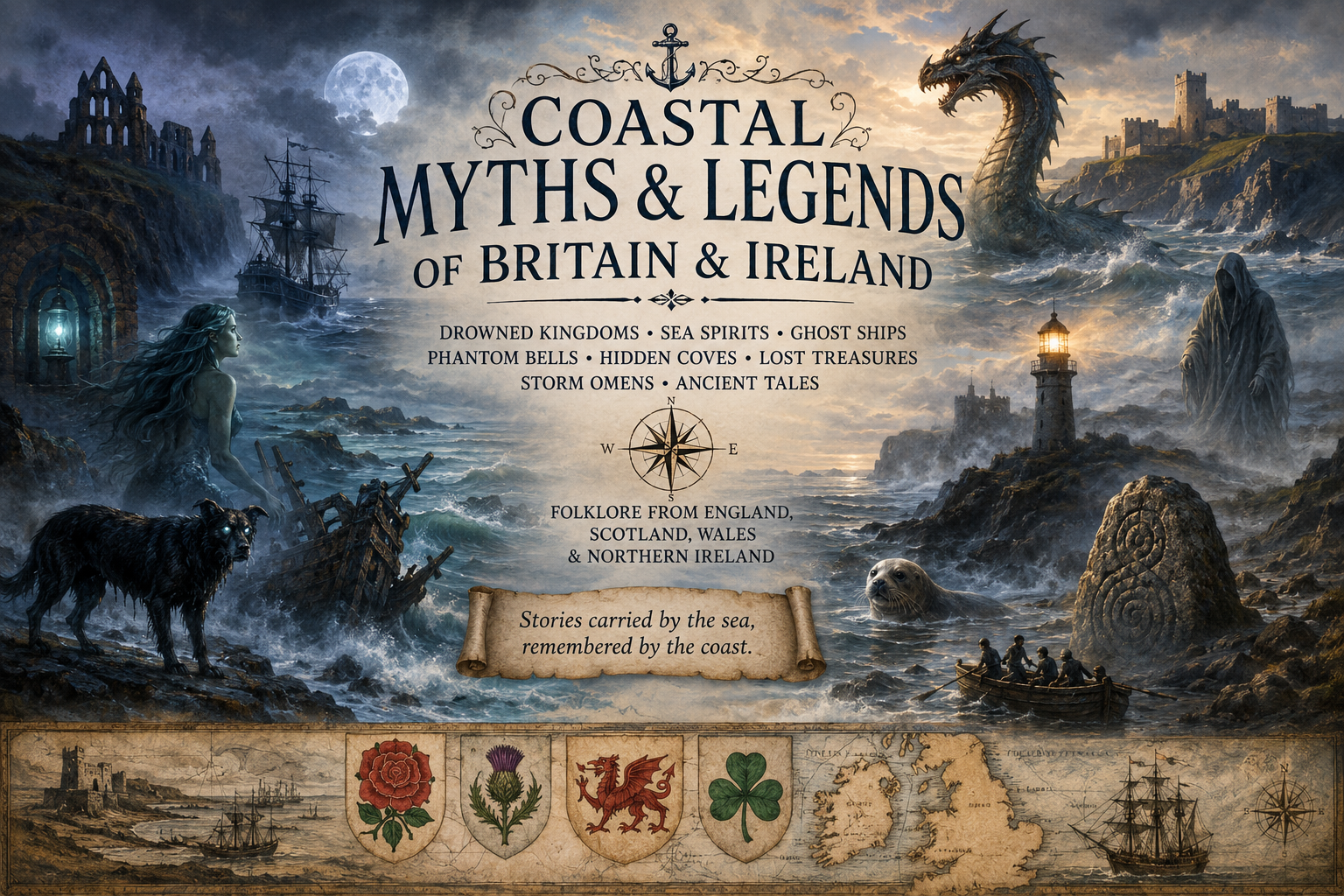
Historically, the firth’s coastal communities have maintained close working relationships with the sea, its fisheries, and the major river systems entering it, including the Spey, Findhorn, Nairn and Ness. In these transitional waters—where fresh and salt water intermingle and tidal streams can run with notable strength—older accounts sometimes describe an ambiguous presence attributed to shifting currents or submerged hazards. In a few retellings, particularly those recorded in nineteenth- and early twentieth-century antiquarian collections, such phenomena were given narrative form through the figure of the kelpie, a shape-shifting water spirit more commonly associated with inland lochs and river pools. Its extension to estuarine conditions within the Moray Firth is likely a regional adaptation rather than a distinct local origin.
There is also occasional mention in oral tradition of “moving water” or “living tides”, a descriptive idiom rather than a clearly personified spirit. These expressions appear to reflect practical seamanship concerns: the rapid development of overfalls off headlands, the strong tidal set near river entrances, and the confused sea that can arise where river discharge meets North Sea swell. It is important to note that such phrasing should not be interpreted as a structured belief in discrete entities governing the tides, but rather as metaphorical language employed by coastal observers to describe unpredictable conditions at sea.
From a maritime perspective, the Moray Firth demands careful attention to tidal timing and local set, particularly off Wick, Cromarty, and the entrances to the Beauly and Dornoch Firths. The shifting sands and shoaling grounds in certain approaches have historically encouraged cautionary storytelling, as is common in many northern waters. Where kelpie references appear in this context, they are best understood as interpretative overlays on navigational risk rather than independent traditions anchored to specific hazards. Modern hydrographic practice has removed much of the ambiguity that may once have given rise to such associations, though the language persists in some cultural references.
Harbour communities along the firth have generally retained a pragmatic outlook, shaped by fishing, pilotage, and offshore trade. Nevertheless, fragments of older belief systems occasionally surface in place-names, anecdotal recollections, and literary treatments of the region’s waters. These should be treated with appropriate caution when assessing their historical weight. The kelpie motif, while widely recognised in Scottish folklore, is not consistently evidenced as a core belief within Moray Firth coastal settlements, and its presence here is better understood as part of a broader national tradition of interpreting water hazards through figurative forms.
In summary, the folklore associated with the Moray Firth remains diffuse and lightly documented, with kelpie and tidal-spirit motifs appearing only intermittently and often in retrospective accounts. The prevailing character of the coastline is more accurately defined by its tidal complexity, exposed headlands, and the meeting of river and sea, which together have provided both the practical challenges of navigation and the conditions in which interpretative folklore has occasionally developed.

Comments