
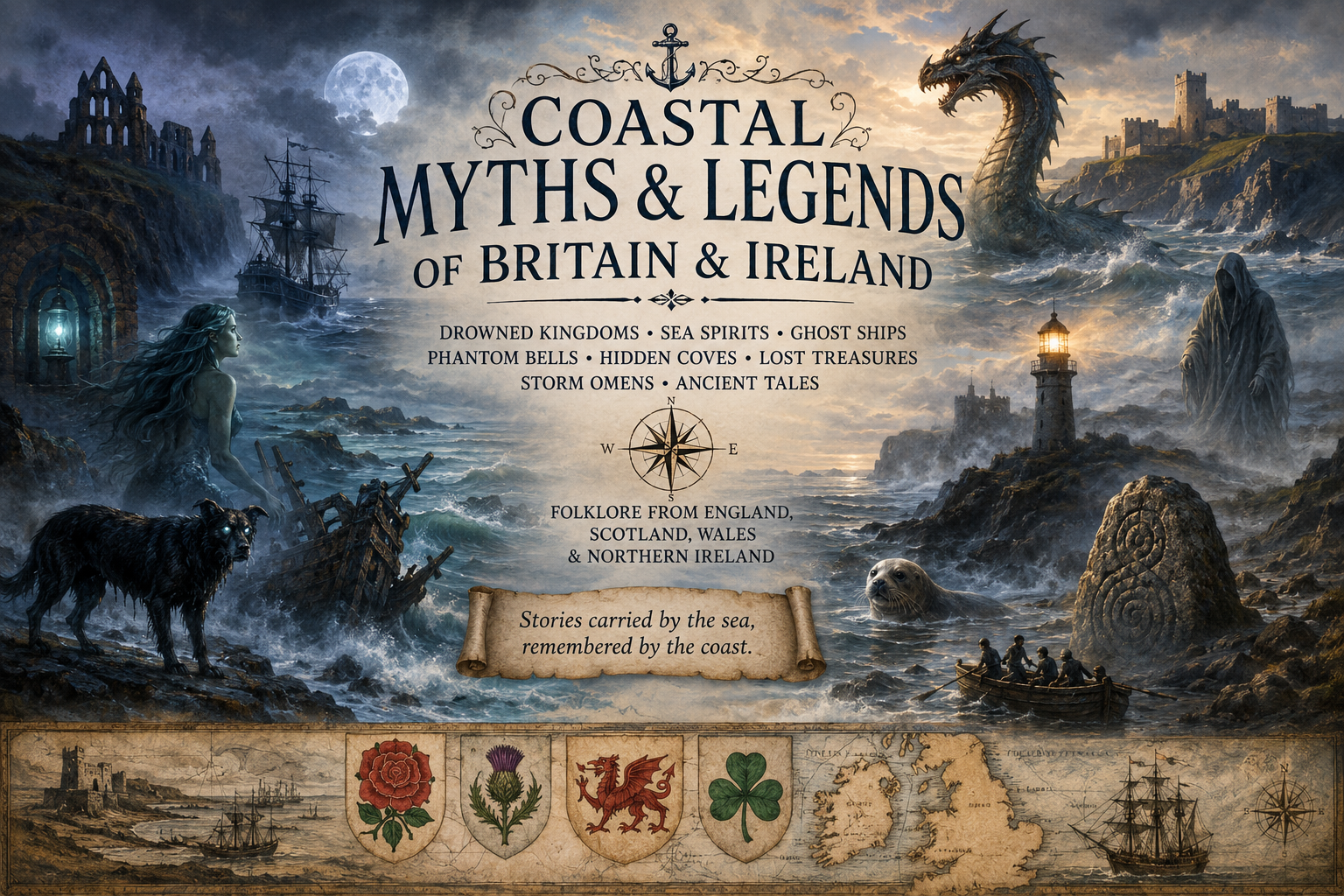



The waters surrounding Shetland have long been associated in local tradition with accounts of the Finfolk, a body of maritime folklore describing sea-dwelling beings said to inhabit the deeper channels and offshore reaches of the northern isles. These traditions are most commonly recorded in Shetland oral culture and, to a lesser extent, in neighbouring Orkney accounts, though their precise origins are uncertain and likely reflect a mixture of Norse influence and local seafaring interpretation of the marine environment.
Within Shetland lore, the Finfolk are generally described not as fixed mythic figures but as a way of interpreting the sea’s unpredictability and its effect on those who worked it. The islands’ position between the North Sea and the North Atlantic exposes them to rapidly changing weather systems, with strong tidal streams, complex coastal topography and deep-water channels such as Yell Sound, Bluemull Sound and the approaches to Bressay and Lerwick. In such conditions, seafarers historically relied upon oral tradition to articulate hazards that were otherwise difficult to predict or measure. The Finfolk tradition is sometimes understood in this context, functioning as a cultural framework for explaining loss at sea or sudden changes in sea state, rather than a literal belief system held uniformly across the islands.
Historical references collected in the nineteenth and early twentieth centuries note that these stories were particularly associated with winter months, when prolonged darkness, heavy seas and limited coastal visibility made navigation between the scattered islands more demanding. The approaches to Sumburgh Head and Fair Isle, for example, are known for strong tidal races and sudden overfalls in adverse conditions, while the eastern seaboard of Mainland Shetland is exposed to long Atlantic swell refracted through the North Sea. It is within such environments that maritime folklore often gains explanatory weight, especially in communities where fishing and small-boat passage were central to daily life.
From a practical seaman’s perspective, the Finfolk narratives should be read alongside other regional traditions that encode environmental knowledge in symbolic form. While not a navigational system in themselves, they reflect accumulated experience of currents, weather and coastline behaviour. Shetland waters are particularly affected by wind funneling through voes and sounds, and by sudden shifts in visibility caused by low cloud and sea fog. In earlier periods, before modern charting and reliable propulsion, such conditions would have required heightened local awareness, often transmitted through stories that reinforced caution in exposed waters.
There is no consistent historical evidence that the Finfolk tradition formed part of formal seamanship practice, nor should it be interpreted as a literal belief system shared uniformly across the islands. Rather, it appears intermittently in recorded folklore as part of a wider North Atlantic narrative tradition concerning the sea as an active and sometimes unpredictable environment. As with many coastal cultures, symbolic explanations for maritime risk coexisted with practical seamanship knowledge, each occupying different aspects of community understanding.
Today, references to Finfolk survive primarily in cultural and literary contexts rather than in working maritime usage. However, the persistence of such accounts remains closely tied to the physical character of the Shetland coastline itself: isolated headlands, deep tidal channels, and extensive exposure to open ocean conditions continue to define navigation in the region. Even in modern operations, the emphasis remains on respect for weather windows, tidal timing and the limitations imposed by geography.
The Finfolk tradition, therefore, is best understood as part of the broader cultural record of Shetland seafaring life, embedded in a coastline where human activity has always been conditioned by the scale and variability of the surrounding sea.


Comments